Project case study
Moynihan Train Hall: Reducing operational risk
The Moynihan Train Hall project demonstrates how sustainability can be strategically applied to reduce long-term operational risk in complex, high-use infrastructure. Delivered through the adaptive reuse of the historic James A. Farley Building, the project integrates energy-efficient systems, resilient design strategies, and verified performance standards to support reliable operations, cost control, and long-term value for a major transportation hub.
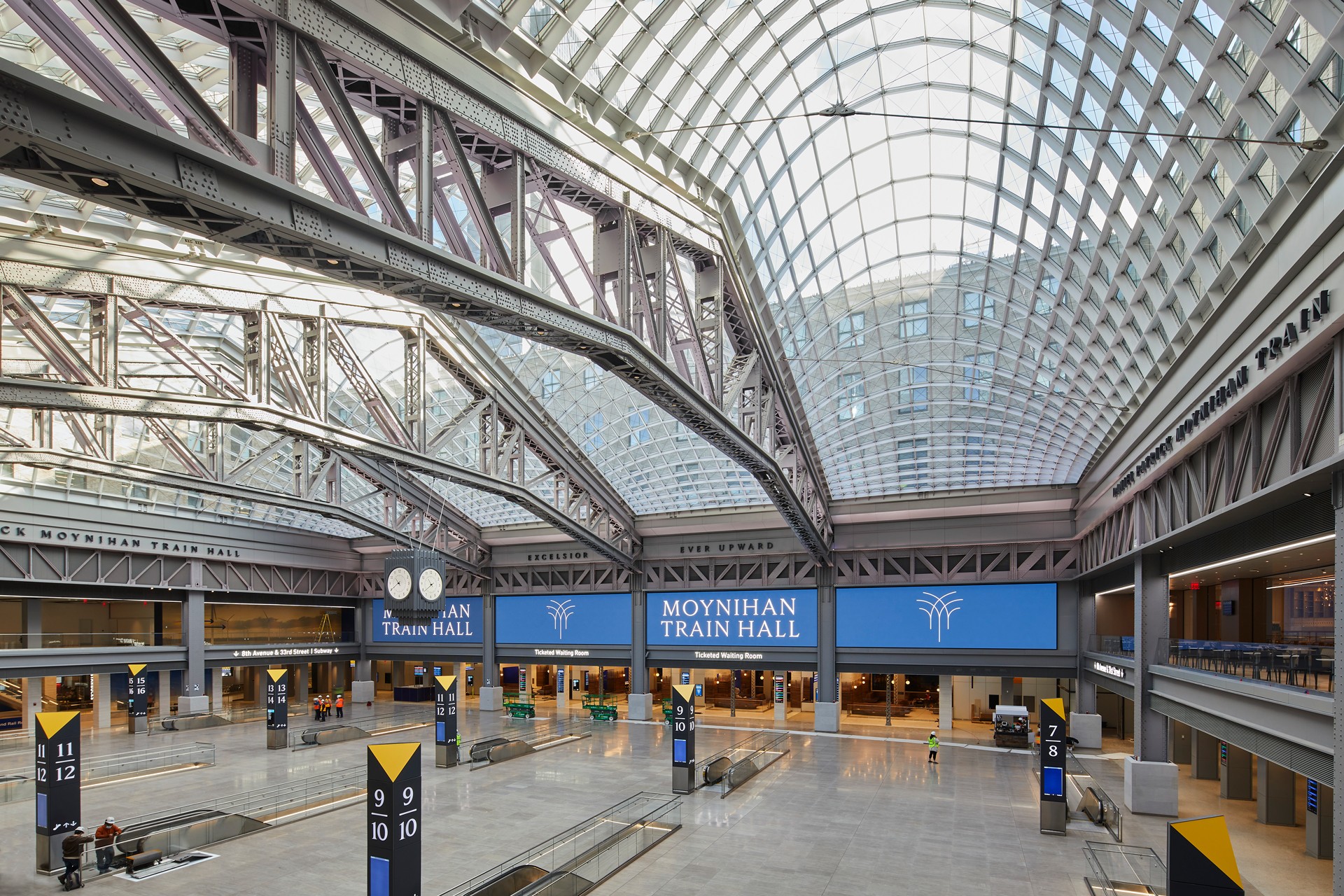
Reducing operational risk was a guiding priority throughout the delivery of our Moynihan Train Hall project. By reusing the existing Farley Building structure, the project preserved embodied carbon and avoided the lifecycle risks associated with new construction, while also minimizing future material replacement and regulatory exposure tied to carbon performance.
The Moynihan Train Hall is distinguished by its expansive one acre, 92-foot-tall glass skylight, which floods the concourse with natural daylight and creates a bright, contemporary transit experience. Our team installed thousands of glass panels atop the Farley Building’s historic steel trusses, preserving the original structure while introducing a modern daylighting system. A series of lightweight grid shell skylights—four spanning the main hall and one over the Midblock corridor—were carefully engineered to maximize illumination, using larger central panels to enhance openness and visual clarity. By uniting advanced structural glass design with the building’s historic fabric, our team delivered a transit hall defined by transparency, light and architectural excellence.
Energy efficiency played a central role in supporting long‑term operational stability. High‑performance mechanical systems, LED lighting, advanced controls and an upgraded building envelope work together to reduce energy demand. The building’s utility and HVAC systems are monitored through an advanced building management platform, supporting consistent performance and proactive maintenance.
Given the scale of the public concourse, our team implemented a radiant, multi‑zone heating and cooling system embedded into the floor slab. By conditioning only occupied areas rather than the full volume of the space, this approach reduces peak loads, limits system strain, and improves long‑term reliability—critical for a transit facility serving hundreds of thousands of daily users.
Enhanced commissioning verified that building systems perform as intended, further reducing the risk of operational disruptions and ensuring efficient, dependable performance over time. In addition, upgrades were incorporated to protect track areas and critical systems, strengthening resilience to extreme weather and climate impacts.
Material reuse also contributed to operational risk reduction. Approximately 70 percent of the original shineau stonework was salvaged and reused, minimizing waste, reducing dependence on new material supply chains, and preserving the building’s historic character while supporting long‑term durability.
Moynihan Train Hall achieved LEED Silver certification and became the first project globally certified under LEED for Transit (Building Design + Construction).
Categories